Home Workout Setup Under $50 (No Big Equipment)
You do not need a home gym. You do not need a treadmill collecting dust. You do not need a squat rack that turns your spare bedroom into a mildly terrifying metal cage.
What you do need is a small, boring, repeatable setup that makes it easy to train three to five days a week without thinking too hard about it. That is the whole game. Less friction. More reps. More consistency.
This is the exact kind of setup I recommend to people who want to get in real, obvious shape at home, without the “influencer gym” vibe.
Under $50. No big equipment. No weird gadgets. Just stuff that works.
The rules (so you do not waste money)
Before the shopping list, a few rules that save you from buying junk.
1. You are not buying “options”, you are buying consistency
Most people buy gear because it makes them feel like they started. Then they stop. The goal is the opposite.
Buy the few items that make the basics easier to repeat:
Squat pattern
Hinge pattern
Push
Pull
Core
Conditioning (optional, but nice)
2. If it takes more than 60 seconds to set up, you will skip it
This is why big equipment fails people. It is not the workout, it is the setup.
3. Comfort matters more than intensity at first
If your hands hurt, your knees hurt, your floor hurts, or you have any underlying conditions like osteoporosis, you will quit. Simple.
The under $50 shopping list (pick these, ignore the rest)
You can do this a couple ways. I am going to give you a “best overall” list that usually lands around $35 to $50 depending on where you buy.
The core setup (what I would buy first)
1) Long loop resistance band (or a small set)
This is the highest return item. A long loop band lets you do:
Assisted pull ups (if you have a bar)
Rows (anchored)
Press variations
Squats, RDLs, good mornings
Face pulls
Curl and triceps work
High rep burnouts that actually feel like lifting
Budget: $10 to $25
If you can only buy one, pick a medium band. If you can buy a set, even better.
2) Door anchor for bands
This is the thing people skip, then they regret it. A door anchor turns bands into an actual home cable station.
You can do:
Lat pull downs (yes, really)
Seated rows
Pallof press
Triceps pushdowns
Face pulls
Budget: $6 to $12
Quick safety note. Use a solid door, close it fully, and pull in the direction that keeps the door shut. If that sentence sounds confusing, just test it gently first.
3) A basic jump rope (optional, but insanely useful)
If you hate running, jump rope is the simplest conditioning tool that fits in a drawer.
Do not overthink this. You do not need a $40 speed rope.
Budget: $7 to $15
If you have cranky shins or you live in an apartment with sensitive floors, you can skip it and do marching intervals, step ups, or shadow boxing.
4) Workout mat (or even just a folded towel for now)
This is not “fitness fluff”. This is what makes you actually get on the floor and do the work.
If your floor is slippery or hard, you will avoid push ups, planks, dead bugs, and stretching. That is like removing half your program.
Budget: $10 to $20
If you already have a yoga mat, perfect. No need to upgrade.
Total cost
Typical total: $33 to $50
That is it.
You can build a genuinely hard, muscle building, sweat producing routine from those items and bodyweight.
The setup itself (how to arrange it so you actually use it)
This part sounds silly. It is not.
Pick a “training square”. A small area you do not have to clear every time. Even if it is just a corner of your bedroom.
What you want in your training square:
Mat already unrolled or easy to grab
Bands in a small bin or hung on a hook
Door anchor already in the same spot (so it becomes automatic)
Rope nearby if you use it
The fewer decisions you make before the workout, the more workouts you do. That is the whole point.
What you can train with this (and how it maps to a real program)
Here is the truth. Most “at home workouts” fail because they are random. A bunch of moves. No progression. No plan.
You want the same core movements each week, and you make them harder over time by:
adding sets
using a thicker band
shortening rest
using harder variations
Below are the key movement patterns and what to do with minimal gear.
Lower body: squat pattern
Bodyweight squats (tempo: 3 seconds down)
Banded squats (band under feet, around shoulders or held in hands)
Split squats
Reverse lunges
Wall sit finisher
Lower body: hinge pattern (this is the “hamstrings and glutes” slot)
Banded RDL (stand on band, hinge, hold ends)
Good mornings (band behind neck, under feet)
Hip hinge to row combo (brutal, in a good way)
Glute bridges (bodyweight, then banded)
Upper body: push
Push ups (incline if needed, decline if strong)
Banded push ups (band across back, under hands)
Overhead press with band (stand on it)
Upper body: pull (the pattern people ignore)
If you do not pull, your shoulders start to feel weird over time. And your posture goes to trash.
One arm band rows (anchored low in door)
Seated rows (anchored)
Face pulls (anchored high)
Straight arm pull downs (anchored high)
Core and “athletic” work
Dead bugs on a mat
Planks (front and side)
Pallof press (band + door anchor, core stabilizer)
Mountain climbers
Hollow body holds (if you are ready)
A simple 3 day routine using only this setup
This is a real template you can run for 4 to 8 weeks. It is not complicated. That is why it works.
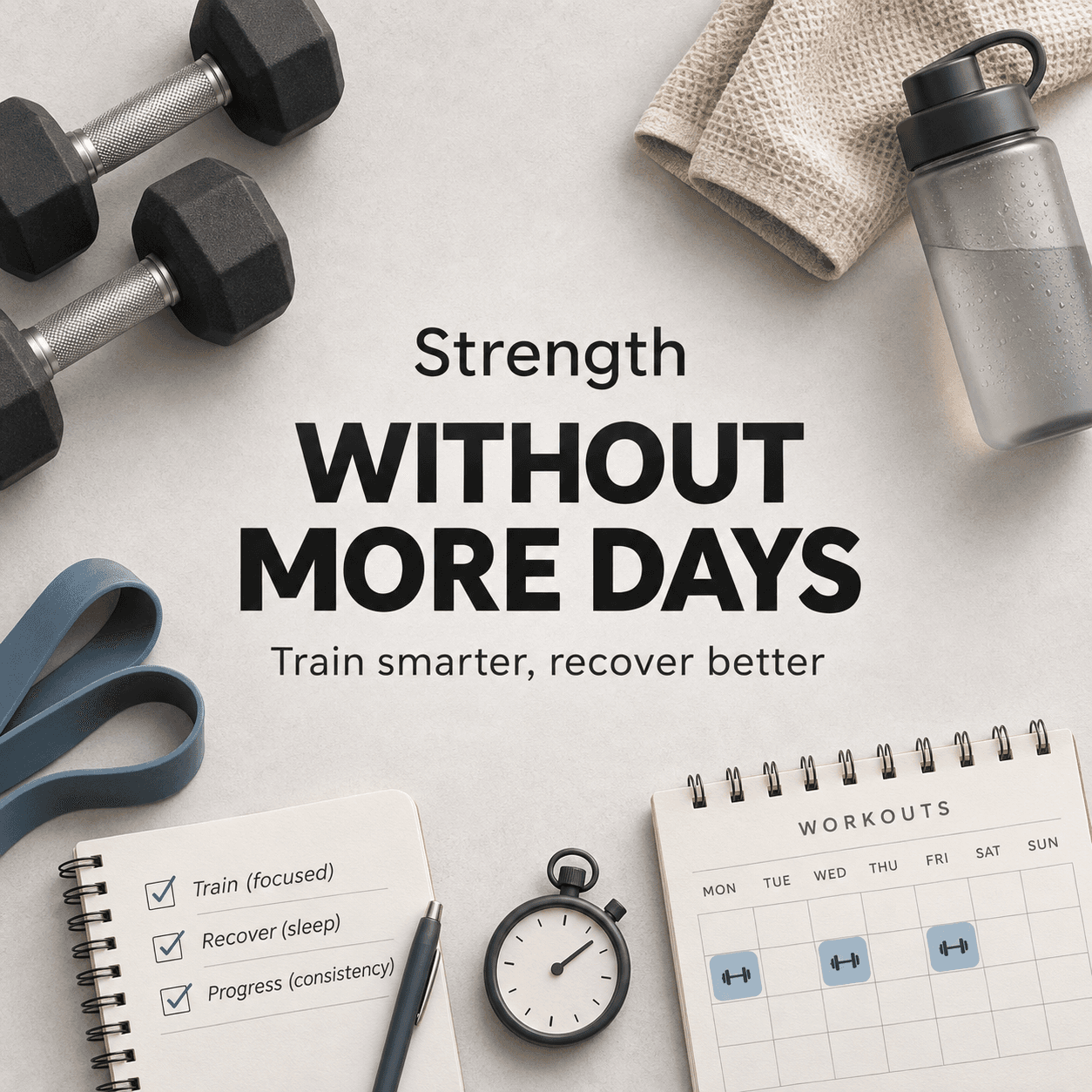
Train 3 days a week. Like Monday, Wednesday, Friday. Or Tuesday, Thursday, Saturday. Whatever.
Day 1: Full body (strength focus)
Split squat: 3 sets x 8 to 12 per leg
Push ups: 3 sets x near failure (leave 1 to 2 reps in the tank)
Banded row (door anchor low): 4 sets x 10 to 15
Banded RDL: 3 sets x 10 to 15
Plank: 3 x 30 to 60 seconds
Optional finisher: 5 minutes jump rope, easy pace.
Day 2: Upper body + core (pump, posture, shoulders)
Banded overhead press: 4 sets x 8 to 12
Banded lat pull down (door anchor high): 4 sets x 10 to 15
Banded push up or close grip push up: 3 sets x 8 to 15
Face pulls (anchor high): 3 sets x 15 to 25
Pallof press: 3 sets x 10 to 15 per side
Optional: 8 minute conditioning interval. Alternate 20 seconds of jump rope or fast marching with 40 seconds of easy walking. Repeat for the full 8 minutes.
Day 3: Lower body + conditioning (feel athletic again)
Squat variation (tempo or banded): 4 sets x 12 to 20
Reverse lunge: 3 sets x 10 per leg
Glute bridge: 4 sets x 12 to 20
Banded row: 3 sets x 12 to 20 (yes again, pulling matters)
Core circuit: 2 to 3 rounds
Dead bug x 10 per side
Side plank x 30 seconds per side
Mountain climbers x 30 seconds
Finish: 5 to 10 minutes jump rope, or brisk stairs, or a fast walk outside.
How to progress without heavier equipment (this is where people get stuck)
If you do the same reps with the same band tension forever, your body stops changing. So you need progression, but it does not have to be fancy.
Here are easy progression methods that work.
Progression method A: add reps, then add band tension
Example with rows:
Week 1: 3x10
Week 2: 3x12
Week 3: 3x15
Week 4: 4x12 (or thicker band)
Progression method B: slow the lowering phase
Take 3 to 5 seconds on the way down. This makes bodyweight squats and push ups feel like a serious lift again.
Progression method C: reduce rest
Keep the same sets and reps, but cut rest by 10 to 20 seconds.
Progression method D: add a set to the main lift
If you can recover well, adding one set to the first two exercises of the day is simple and effective.
What about “movie star shape” at home?
This is the part people secretly care about. Not PRs. Not being a powerlifter. They want to look good in a shirt. Look lean. Arms, shoulders, chest. A back that shows. Legs that look trained.
Good news. You can absolutely build that at home.
You just need:
enough weekly volume (sets that challenge you)
consistent progression
a plan you repeat long enough to work
This is basically the philosophy behind the training guides over at Freedom’s Fitness. Straightforward programming, no noise, no goofy complexity, just workouts that you can actually follow. If you want a structured PDF program you can run at home (or in a gym later), you can browse the programs here: https://www.freedomsfitness.com/
Not a hard sell. Just a genuinely useful next step if you are tired of piecing things together from random videos.
A few “do not buy” items (save your money)
Some stuff looks helpful, but for a beginner or intermediate home setup under $50, it is just distraction.
Tiny pink dumbbells
You will outgrow them in a week. Unless you specifically want them for rehab or very light shoulder work.
Ab gadgets
You do not need them. Planks, dead bugs, hollow holds, and Pallof presses will light up your core.
Heavy weighted vest (right away)
It can be great later. But it usually blows the budget and changes exercise mechanics before you have clean movement.
Huge door gym systems
If you want one later, cool. But the whole point here is low cost, low setup, high repeatability.
The “I live in an apartment” version
If noise is a problem:
Skip jump rope, do step ups on a stable chair or low bench (careful)
Do shadow boxing rounds on a mat
Do slow tempo squats and lunges (they hurt, quietly)
Add more band work for conditioning style circuits
A simple quiet finisher:
30 seconds mountain climbers
30 seconds rest Repeat 8 times.
FAQ (quick answers that actually help)
Can I build muscle with just bands and bodyweight?
Yes. Especially if you train close to failure, progress week to week, and do enough sets for each muscle group.
How many days a week do I need?
Three solid days works. Four is great. Five is fine if you keep sessions shorter and recovery is good.
What if I cannot do push ups yet?
Start with incline push ups on a countertop, sturdy table, or wall. Bring the incline down over time.
What if I cannot “feel” my back on rows?
Slow down. Pause for 1 second with the band fully pulled. Think elbows back, chest tall. You will get it.
A simple checklist (so you can do this today)
If you want to keep it dead simple, do this:
Buy a long loop resistance band (or set)
Buy a door anchor
Use any mat you already have (or grab a cheap one)
Optional: jump rope
Pick a 3 day routine and run it for 6 weeks without changing it every three days
That is the boring secret. Same plan, long enough to work.
If you want a clean, follow along structure that removes the guesswork, check out the downloadable training programs at Freedom’s Fitness here: https://www.freedomsfitness.com/ They are built for people who want results without turning fitness into their entire personality.
And yeah. Under $50, you can absolutely get started. You just need to start.

Comments