What to Do When You Miss a Week (No Restart)
You miss a week.
Maybe it was travel. Maybe work exploded. Maybe you got sick, the kids got sick, your sleep went sideways, your motivation fell into a ditch. Whatever.
And then your brain does that thing where it goes:
“Welp. I ruined it. Might as well restart Monday.”
No. You do not need a restart.
You need a re entry.
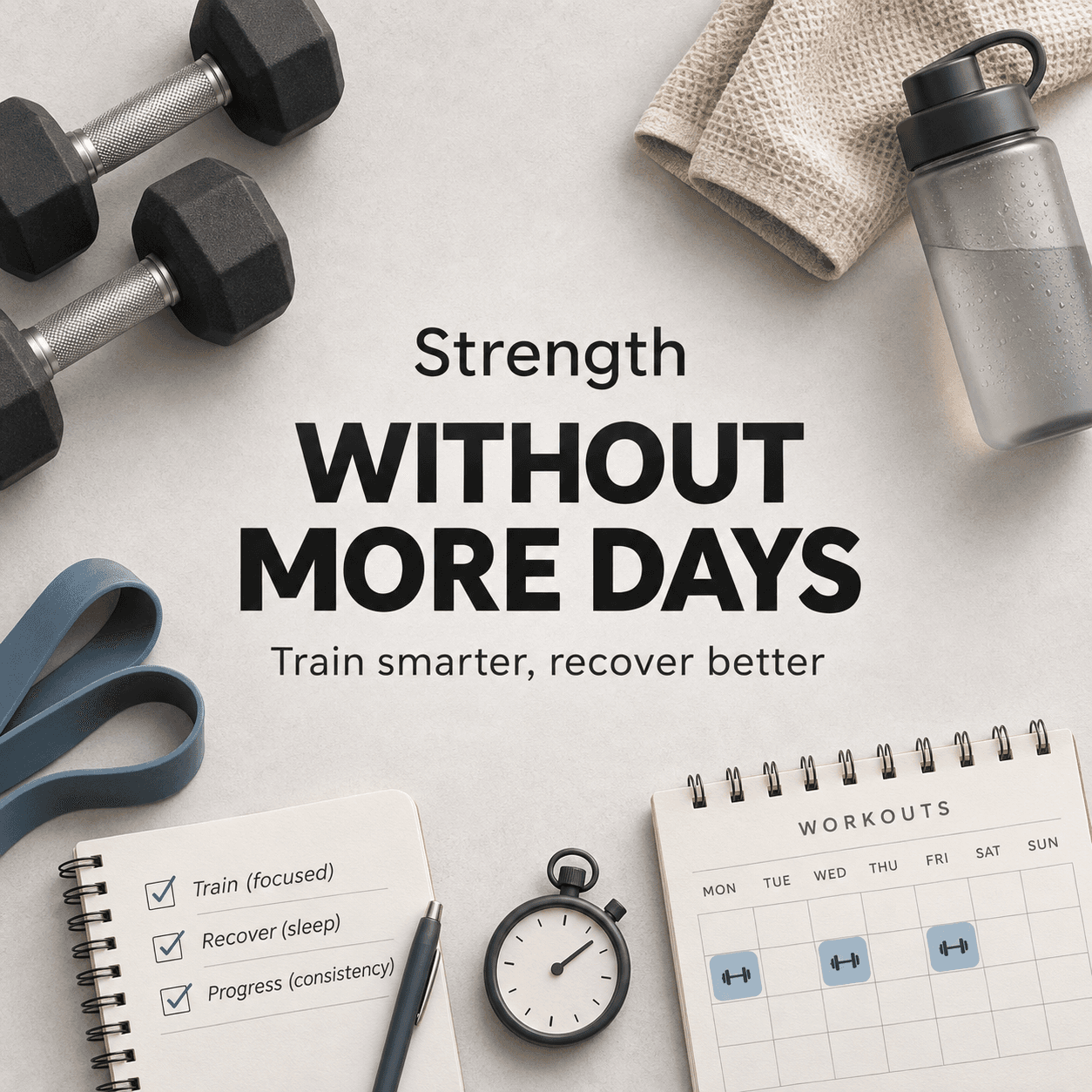
Because fitness is not a streak. It is not a perfect calendar. It is you doing the next sensible workout, in the next sensible way, with the body you have today.
Let’s make this simple and usable.
First, stop calling it “falling off”
Missing a week is not falling off anything. Life is not a straight line.
A missed week is just a gap. And gaps happen even to people who look like they never miss. They just don’t dramatize it. They don’t treat it like a moral failure. They just go train.
So the goal here is not to punish yourself with a “restart” or a detox week or some brutal make up plan.
The goal is to slide back into momentum without getting sore enough to hate your life.
The only rule: don’t try to “make up” the missed sessions
This is the big mistake.
You miss 3 workouts, so you try to do 6 workouts next week. Or you double your volume. Or you go full hero mode to prove something.
That’s how you turn a small break into an injury, or at least a soreness hangover that makes you miss another week.
Your body detrains a little during a week off, sure. But not enough to justify panic.
Your joints, tendons, and nervous system are the limiting factor when you come back, not your lungs. Not your grit. Your tissues.
So we’re going to be boring about it. Boring is how you stay consistent.
Step 1: Decide what kind of “missed week” it was
Not all missed weeks are the same. This matters.
A) Life got busy, but you feel fine
You didn’t train. But you slept okay, ate normal, no illness. You’re basically good.
B) You were sick or run down
You’re better now, but still not 100 percent. This needs a softer landing.
C) You were traveling, under slept, under fed
You might feel “okay” but everything is tight and cranky. Your recovery has been weird.
D) You tweaked something
Back, shoulder, knee, whatever. Even a mild tweak changes the plan.
If you pick the right category, the next steps feel obvious. If you don’t, you’ll guess wrong and make it harder than it needs to be.
Step 2: Do the “bridge workout” (your return session)
This is the session that reconnects you to training without wrecking you.
It should feel almost too easy while you’re doing it. That’s the point. You are greasing the groove again.
The Bridge Workout Template (Full Body, 35 to 50 minutes)
Pick weights that feel like you could do 3 to 4 more reps at the end of each set.
Squat pattern (goblet squat, leg press, bodyweight squat) 2 sets of 8 to 10
Hinge pattern (Romanian deadlift, hip hinge, glute bridge) 2 sets of 8 to 10
Push (dumbbell bench, pushups, machine press) 2 sets of 8 to 12
Pull (lat pulldown, cable row, dumbbell row) 2 sets of 8 to 12
Carry or core (farmer carry, plank, dead bug) 2 rounds, easy effort
That’s it.
No PR attempts. No “let me see where I’m at.” You already know where you’re at. You missed a week. You’re at “back to work, calmly.”
If you train at home with limited equipment
Same structure, different tools.
Squat: bodyweight squats or split squats
Hinge: hip hinges with a backpack, or glute bridges
Push: pushups or dumbbell floor press
Pull: one arm rows with a dumbbell, band rows, or towel rows if you’re creative
Core: plank variations
The goal is movement quality and a sweat, not annihilation.
Step 3: Use the 80 percent rule for the first week back
For the first week back, you’re going to do your normal plan… at about 80 percent.
What does that mean in real life?
Use 80 percent of the weight you were using before the break, or
Do 80 percent of the sets, or
Stop every set 2 to 3 reps shy of failure
Pick one. You don’t need to do all three.
If you were doing 4 sets, do 3. If you were doing 50 pound dumbbells, use 40s. If you were going to failure, don’t.
This one move prevents the classic “I’m back!” soreness spiral.
And yeah, you might feel like you’re holding back.
Good. That means you’re doing it right.
Step 4: Don’t change programs just because you missed a week
This is another sneaky one.
People miss a week and then decide the program “isn’t working.” So they start shopping. They switch routines. They add new exercises. They rewrite everything.
But you didn’t even do the plan last week.
You don’t need novelty. You need reps. Weeks of reps.
So unless you truly hate the program, you keep it. You return to the same plan, same structure, same days.
Especially if you’re using a straightforward PDF program (the kind where you just open it and do the workout, no drama), it’s literally built for this. You hop back in.
If you’re looking for that kind of no noise structure, Freedom’s Fitness programs are basically made for re entry. Simple workouts. Clear progression. No 19 page meal plan that collapses the moment life gets busy. You can browse the training guides here: https://www.freedomsfitness.com/
Subtle plug, yes. But it’s relevant. Most people don’t need more info, they need a plan they can return to without a full identity crisis.
Step 5: Where do you start in the schedule?
This is the question that messes people up.
You open your program and think:
“Do I restart Week 1? Do I repeat last week? Do I skip ahead?”
Here’s the rule that keeps it clean.
If you missed 1 week or less
Pick up where you left off.
If your next workout is Day 3, do Day 3. Even if the calendar date says you “should” be on Week 5. Calendars are not real.
If you missed 2 weeks
Repeat the last full week you completed. Not from the beginning of time. Just repeat the last successful week.
If you missed 3 weeks or more
Run a 1 week ramp in (bridge week), then continue.
And ramp in just means the 80 percent rule for a week, then you’re back to normal.
That’s it. No ritual restart required.
Step 6: Handle the mental “I’m behind” feeling
This part is real. You miss a week and it feels like you lost something.
You didn’t. You paused.
But if your brain is loud about it, here are a few fast reframes that actually work.
“I’m not behind, I’m just not done”
Training is not a semester. There is no final exam. There is no due date unless you’re prepping for something specific.
“The plan still works even if I’m imperfect”
A good program has slack built into it. It assumes you’re human.
“My next workout is the only one that matters”
Not the week you missed. Not the guilt. Not the spreadsheet.
Just the next workout.
If you do the next one, you’re back.
However, it's important to acknowledge that these feelings of anxiety and worry can sometimes be overwhelming, especially for older adults who might be experiencing anxiety and older adults. Remember, it's okay to seek help if these feelings become too much to handle alone.
Step 7: If you’re sore when you return, don’t get dramatic
You might get sore even with a careful return. That’s normal.
What you do next matters:
Do not take another full week off because you’re sore.
Do lighter training and keep moving for 1 to 3 days.
If you can, do:
20 to 30 minutes walking
light bike
light pump work, easy sets
mobility that feels good (not aggressive stretching that makes you feel like a pretzel)
And drink water. Eat protein. Sleep. Basic stuff, annoyingly effective.
Step 8: If you missed because motivation died, fix the environment, not your personality
If the missed week happened because you “just didn’t feel like it,” that’s not a character flaw. That’s a system problem.
A few quick fixes that help fast:
Make the workouts smaller
Tell yourself: “I’m just going to do the first 10 minutes.”
You can quit after 10 minutes. Seriously. Give yourself permission.
Most of the time you won’t quit once you start. But the permission removes the pressure.
Lower the friction
Pack your gym bag the night before.
Keep your program open on your phone.
Decide the workout time in advance.
Keep the promise tiny
If you’re in a slump, commit to two workouts this week, not five.
Two workouts done is infinitely better than five workouts planned.
And it rebuilds the identity: “I’m the kind of person who trains.”
Step 9: If you missed because life is chaotic, use the “minimum effective week”
This is the version where your schedule is a mess. You’re not lazy. You’re overloaded.
So instead of trying to force your normal routine, you run a minimum effective week.
Here’s one that works for almost everyone:
Minimum Effective Week (2 days)
Day A:
Squat variation: 3 sets
Push variation: 3 sets
Pull variation: 3 sets
Day B:
Hinge variation: 3 sets
Push variation: 3 sets
Pull variation: 3 sets
That’s it. Two days. Full body. Done.
If you can add a third day, great. If not, you still maintained the habit and most of your progress.
And when life calms down, you slide back into your normal schedule.
No restart. Just scaling.
Step 10: What if you missed and you feel “weaker”?
You probably are. A little.
And that is fine.
Strength is not a one way street. It goes up, it goes down, it goes up again. The people who get in great shape are not the ones who never dip. They’re the ones who don’t freak out when they dip.
Here’s what you do:
Drop the load slightly.
Keep the technique clean.
Add reps or weight again over the next 2 to 3 weeks.
It comes back quickly. Faster than you think.
And if you track even one thing, track this: you showed up again. That’s the whole game.
A simple “No Restart” checklist (save this)
If you want something you can literally follow next time:
Missed a week? Okay. Normal.
Do a bridge workout (2 sets per movement).
Run the 80 percent rule for your first week back.
Continue the program where you left off.
Do not make up missed workouts.
If life is chaos, do the minimum effective week.
After 7 to 10 days back, return to normal intensity.
That’s it.
Not sexy. Very effective.
One more thing (because someone needs to hear it)
You are allowed to be a person who trains… and also misses weeks sometimes.
Consistency is not perfection. Consistency is returning.
So go do the next workout. The next reasonable one. Even if it’s lighter. Even if it’s short. Even if you don’t feel like it yet.
And if you want a plan that’s easy to come back to without overthinking, take a look at the training programs at Freedom’s Fitness: https://www.freedomsfitness.com/
Pick one. Download it. Put it on your phone. When life happens again, and it will, you’ll know exactly what to do.
No restart. Just re entry.

Comments