No Time? Use This 2-Exercise Workout Template
Most people don’t “quit” the gym because they hate training.
They quit because life gets loud.
Work runs late. Kids get sick. The commute eats an hour. You finally get a free pocket of time and your brain goes, cool… now what’s the plan?
And that’s the real problem. Not motivation.
It’s decision fatigue.
So this is for the days you have 20 to 35 minutes. Maybe 15 if you move with purpose. The days where a full workout feels impossible, but doing nothing feels worse.
A simple 2-exercise template. That’s it.
Not a “hack”. Not a secret sauce. Just a repeatable structure you can run for months and still make visible progress.
If you want it.
The idea (and why it works)
A good workout doesn’t need 8 exercises. It needs:
One big movement that uses a lot of muscle and lets you progress over time
One supporting movement that fills the gap, adds volume, and keeps you balanced
That’s basically it.
Progress comes from doing the basics, consistently, and adding a little more over time. More reps. More weight. Cleaner form. Shorter rest. Better effort. Pick one.
Also, two exercises keeps you honest.
Because when you only have two things to do, you can’t hide behind “busy work”. You actually have to train.
What you need before you start
Not much, but a few guardrails help.
1) Pick exercises you can progress
If you choose something random every workout, you can’t track improvement. So pick movements you can repeat.
2) Don’t pick two exercises that fight each other
Two hard lower body moves back to back can work, but it can also turn into a form breakdown festival. Pair smart.
3) Leave 1 to 2 reps in the tank most sets
You’re not trying to max out every session. You’re trying to show up again tomorrow, or the next day, without feeling wrecked.
The 2-Exercise Workout Template (the one to save)
Here’s the template. Screenshot it. Copy it into your notes app. Whatever.
Exercise A (Primary Lift)
4 to 6 total sets
5 to 10 reps per set
Rest 90 to 180 seconds
Stop with 1 to 2 reps in reserve (most sets)
Exercise B (Secondary Lift)
Choose one option depending on time and mood:
Option 1: Straight sets
3 to 5 sets
8 to 15 reps
Rest 60 to 120 seconds
Option 2: Density block (fast and nasty)
Set a timer for 8 to 12 minutes
Do small sets, rest as needed
Goal: accumulate quality reps
That’s the whole thing.
And yes, it counts as a real workout.
Images (so you can visualize it quickly)
You can drop these into the post, or swap them for your own later.
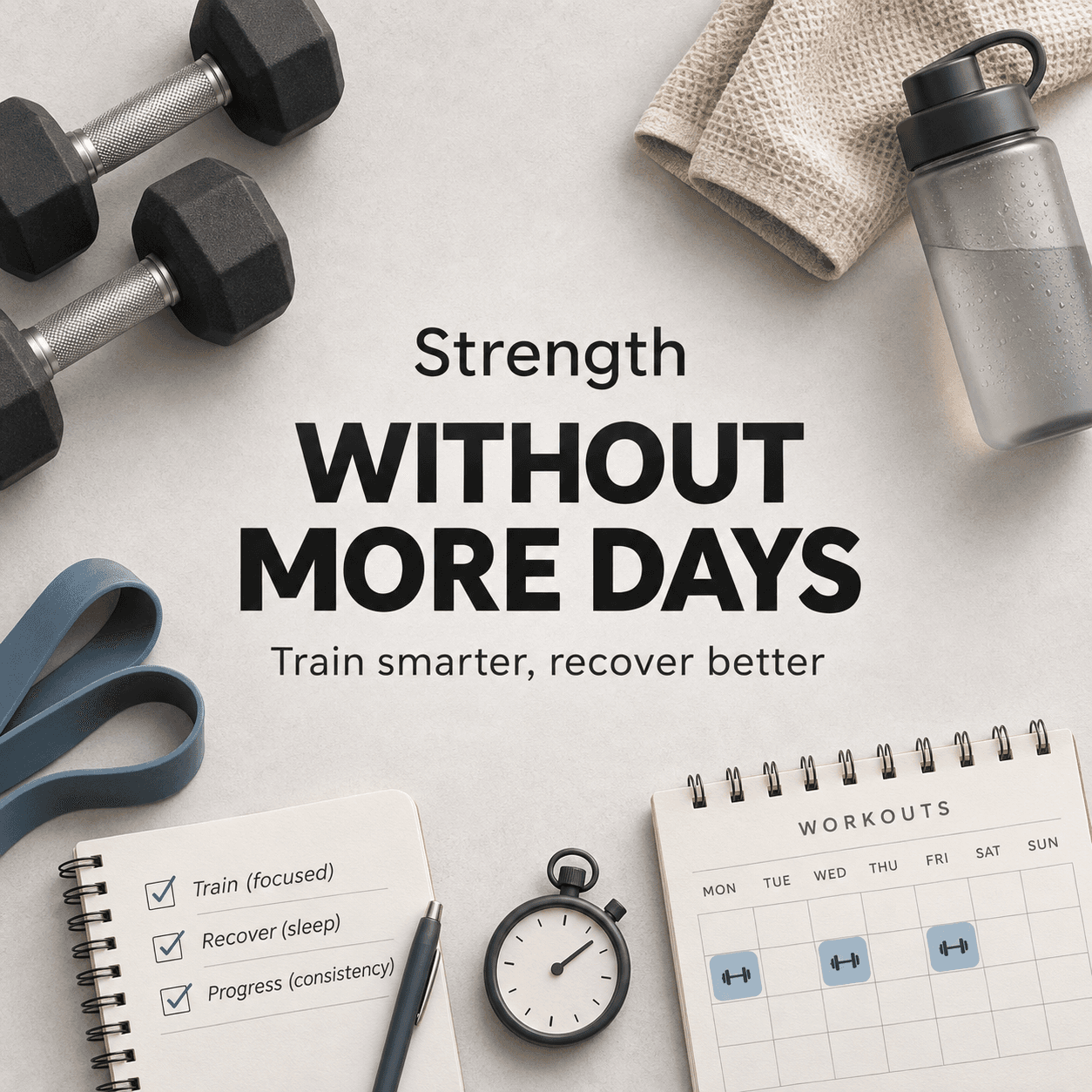
Template graphic
Busy schedule vibe
Simple training setup
Step 1: Pick your “A” exercise (the anchor)
Your A exercise should be one of these patterns:
Squat
Hinge
Press
Pull
Big, boring, effective.
Here are solid options.
Gym options (A exercise)
Back squat or front squat
Trap bar deadlift or Romanian deadlift
Bench press or incline dumbbell press
Weighted pull ups or heavy cable row
Home options (A exercise)
Goblet squat (heavy) or split squat
Dumbbell Romanian deadlift
Dumbbell floor press or push ups (weighted if possible)
One arm dumbbell row or pull up (doorframe bar if you have one)
If you’re stuck, pick the one you can perform with the best form and least joint drama. Progress beats ego.
Step 2: Pick your “B” exercise (the glue)
B is where you round out the workout.
If A is a squat, B might be a pull or a hinge. If A is a press, B should probably be a pull. Simple.
Good B exercises:
Romanian deadlift (if A is squat)
Bulgarian split squat (if A is hinge)
Chest supported row (if A is press)
Push ups or dips (if A is pull)
Lat pulldown, cable row, dumbbell row
Hamstring curl, leg press, hip thrust
Lateral raises, curls, triceps work (if you need quick pump volume)
Yes, “small” stuff can be B. Especially if A is heavy and you’re short on time.
The 4 best pairings (steal these)
These cover almost everyone. They're hard to mess up.
1) Squat + Row (full body, balanced)
A: Squat variation B: Row variation
Why it works: legs and back, lots of total muscle, minimal overlap.
Examples:
Back squat + cable row
Goblet squat + one arm dumbbell row
Front squat + chest supported row
2) Hinge + Press (strengthy, athletic)
A: Deadlift or RDL variation B: Bench or overhead press variation
Why it works: posterior chain plus upper body push. Feels like you did something.
Examples:
Trap bar deadlift + incline dumbbell press
Dumbbell RDL + push ups
Barbell RDL + bench press
3) Press + Pull (upper body in 25 minutes)
A: Bench or overhead press B: Pull up / pulldown / row
Why it works: classic push pull. Easy to progress. Shoulders stay happier.
Examples:
Incline DB press + pull ups
Bench press + cable row
Overhead press + lat pulldown
4) Split squat + RDL (home leg day that actually hits)
A: Bulgarian split squat B: Dumbbell RDL
This one is sneaky brutal. Especially if your dumbbells aren't super heavy. Your lungs will notice.
How to warm up without wasting time
Warm ups are important. Long warm ups are optional.
Do this:
1 minute of brisk walking, biking, or jumping jacks.
2 quick mobility moves for what you're training that day.
2 to 4 ramp-up sets for Exercise A, working up gradually before your first work set.
Mobility move suggestions by exercise type
Squats: bodyweight squats + hip hinges
Presses: band pull aparts + push ups
Pulls: scap pull ups + light rows
That's it.
If you have exactly 15 minutes, just ramp with lighter sets and go.
Progression (this is where results come from)
This template works if you progress it.
Here are two dead simple ways.
Option A: Double progression (my favorite)
Pick a rep range, like 5 to 10.
Stay at the same weight until you hit the top of the range for all sets
Then increase weight next time and go back to the lower end
Example:
Bench press 4x5 to 10
Week 1: 4x6
Week 2: 4x7
Week 3: 4x8
Week 4: 4x9
Week 5: 4x10
Week 6: add weight, back to 4x6-ish
Simple. Trackable. Works forever.
Option B: Add a set before you add weight
If you’re training at home and weight jumps are hard:
Start with 4 sets
Build to 6 sets over time
Then increase weight or difficulty
What this looks like in real life (3 examples)
Because templates sound good until you’re standing there like… ok but what do I do today.
Example 1: 25 minute gym workout (full body)
Warm up: 5 min total A: Back squat 5 sets of 5 to 8 B: Chest supported row 4 sets of 10 to 12
Done.
Example 2: 20 minute home workout (dumbbells)
Warm up: 3 to 4 min A: Dumbbell RDL 5 sets of 8 to 10 B: Push ups 10 minute density block Do sets of 6 to 12, rest as needed, keep form clean.
Example 3: 30 minute upper body (simple, effective)
Warm up: 5 min A: Incline dumbbell press 5 sets of 6 to 10 B: Lat pulldown 5 sets of 8 to 12
You will feel this. In a good way.
The “I literally have 15 minutes” version
Ok. You’re in a rush.
Do this:
A: 3 hard sets (5 to 10 reps)
B: 6 minute density block
That’s it. No guilt. No overthinking. Get in, get out.
If you do this 3 times a week, you’re not “falling off”. You’re training.
Common mistakes (so you don’t accidentally waste your time)
Mistake 1: Turning it into cardio with weights
If rest times are too short on A, your strength stalls fast. Breathe. Lift well.
Mistake 2: Picking “A” exercises that are too technical
If your A lift takes 20 minutes to set up and film and perfect, you won’t stick to it.
Save Olympic lift variations and complicated stuff for seasons of life where you have time.
Mistake 3: Going to failure every set
Failure has a place. But not as your entire personality.
Leave a rep or two in the tank. Especially on A.
How to schedule this during a busy week
This is the part people ask me most, and it’s almost boring.
If you can train 2 days per week
Alternate these two workouts:
Workout A: Squat + Row
Workout B: Hinge + Press
That covers everything.
If you can train 3 days per week
Do:
Day 1: Squat + Row
Day 2: Press + Pull
Day 3: Hinge + Single leg (or hinge + row)
If your schedule is chaos
Pick one pairing and repeat it until life calms down.
Progress is boring. Boring works.
Want a done-for-you plan that stays simple?
If you like this “no noise” style of training, you’ll probably like what we publish at Freedom’s Fitness.
The whole point of the site is straightforward programs that get you in legit shape without needing to decode the fitness industry every week.
You can check out the training guides here: https://www.freedomsfitness.com/
They’re PDFs, instant access, and built around the same idea you’re using today. Simple structure. Real progression. No fluff.
Quick FAQ (because yes, you’re going to wonder)
Is this enough to build muscle?
Yes, if effort is high and you progress. Two exercises done hard beats ten exercises done half asleep.
What if I want abs or arms?
Put them at the end as a 5 minute add on, 2 to 3 short sets.
But keep the template the template. Don’t ruin it by turning it into a 90 minute “quick workout”.
Can I do this 5 days a week?
You can, but most people shouldn’t. Two to four days per week is the sweet spot.
Wrap up
On busy days, the goal is not the perfect workout.
It’s the workout you actually do.
Pick an A lift. Pick a B lift. Do the sets. Track it. Add a rep next time. Or add a little weight. Then leave.
That’s the whole thing. And honestly it’s kind of freeing.
Because when training is this simple, you stop negotiating with yourself.
You just start.

Comments